


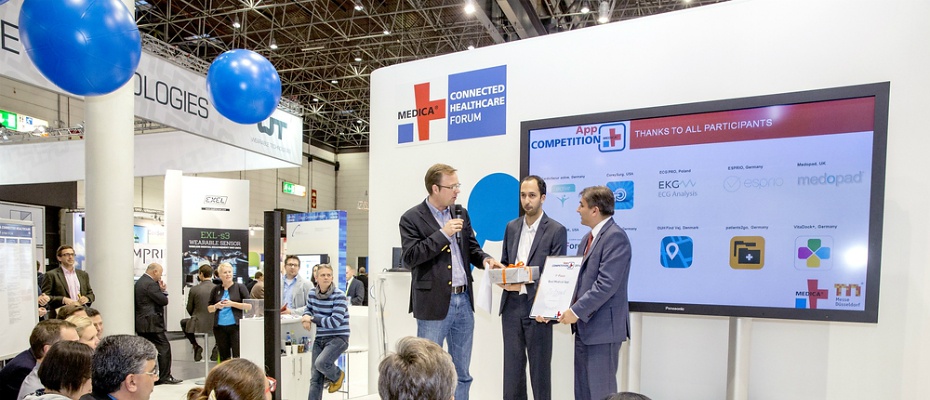
When people talk about the importance of business trade fairs, they usually focus on their commercial impact. And for good reason. These events bring together companies, researchers, healthcare professionals, and industry experts to exchange ideas, discover new products, build partnerships, and explore technologies that could shape the future of their industries.
But some trade fairs have an impact that goes far beyond business.
Few are better examples than MEDICA – one of the world's leading medical trade fairs. Held annually in Düsseldorf, Germany, MEDICA brings together an international community of healthcare professionals, medical technology companies, researchers and decision-makers.
Increasingly, the event has also become a showcase for technologies that could change how healthcare is delivered.
Artificial intelligence, robotics, wearable sensors, digital twins, non-invasive diagnostics and connected medical devices are no longer futuristic concepts. Many are already being developed and demonstrated by companies exhibiting at MEDICA.
Recent editions of the event have provided a glimpse of just how quickly medical technology is evolving. In 2025 alone, hundreds of health-tech startups presented their ideas, with the MEDICA Start-up Park featuring around 80 international teams.
So, rather than looking back at innovations first presented more than a decade ago, let's take a look at some of the newer technologies showcased through MEDICA's innovation programmes.
Sepsis is one of the most serious complications that can occur during an infection. For healthcare professionals, identifying deterioration early can be critical.
One of the technologies presented through the MEDICA 2025 Start-up Competition came from Aisthesis Medical, a UK-based health-tech company developing its VIOSync Sepsis Prediction Index.
The platform uses hospital data and explainable artificial intelligence to identify patterns associated with the development of sepsis. According to MEDICA, the technology is designed to potentially identify the onset of sepsis up to 48 hours in advance, giving medical teams additional time to assess patients and intervene.
The important development here isn't simply "AI in healthcare." It is the shift towards systems that can continuously analyse large amounts of clinical information and highlight potential risks to healthcare professionals.
AI is therefore moving from being primarily an analytical tool to becoming an additional layer of support within clinical workflows.
Of course, technologies like these still require appropriate clinical validation, regulation and human oversight. But the direction of development is clear: healthcare providers are increasingly looking at AI to help identify patterns that could otherwise be difficult to spot quickly.
What if a patient's breath could provide useful information about their health?
That is the idea behind Nanose Medical, which won the 2025 Healthcare Innovation World Cup at MEDICA.
The Israeli company is developing a compact system that analyses compounds in human breath in real time. The goal is to identify biomarkers associated with diseases, potentially including cancer and chronic conditions.
The concept is particularly interesting because breath analysis could offer a completely different approach to medical screening.
Instead of relying exclusively on blood samples or imaging, healthcare professionals could potentially use molecular information contained in exhaled air as another source of diagnostic data.
The technology is still an emerging approach rather than a universal replacement for established diagnostic methods. But it illustrates one of the most exciting trends in modern healthcare: developing diagnostic techniques that are faster, less invasive and potentially easier to deploy.
Some of the most vulnerable patients in healthcare are premature and critically ill newborns.
Monitoring oxygen levels in the brain can be particularly important because inadequate oxygenation can cause serious complications. Traditionally, monitoring physiological parameters in newborns can require sensors or procedures that are not always ideal for fragile patients.
At the 2025 Healthcare Innovation World Cup, Swiss company OxyPrem AG presented optical, non-invasive sensors designed to continuously monitor oxygen levels in the brains of premature and newborn babies. The company took third place in the competition.
The technology represents another important direction in medical device development: continuous monitoring without invasive procedures.
Rather than waiting for a problem to become obvious, connected sensors can potentially provide healthcare professionals with a continuous stream of information about a patient's condition.
This trend is also visible well beyond neonatal care, with wearable and remote-monitoring technologies becoming an increasingly important part of modern healthcare.
Another example from the 2025 Healthcare Innovation World Cup came from Swedish company Acorai.
The company is developing technology for non-invasive measurement of heart and lung blood pressure. Its platform combines several types of measurements, including vibration, acoustic, optical and electrical signals, with the aim of supporting healthcare professionals caring for people with heart failure.
The significance of this kind of technology lies in its potential to make complex physiological information easier to obtain without relying on invasive procedures.
It also demonstrates how modern medical devices are increasingly combining multiple sensors and data sources rather than relying on a single measurement.
This convergence of sensors, software, and data analysis is becoming one of the defining characteristics of next-generation medical technology.
Automated external defibrillators, or AEDs, can be lifesaving during cardiac emergencies. But accessibility and ease of use remain important considerations when every second matters.
At MEDICA 2025, US-based HeartHero presented a wearable, user-friendly AED designed to automatically deliver a shock only when it determines that one is needed. The device was among the innovations featured in the MEDICA Start-up Park.
The concept reflects a broader movement in healthcare technology: taking medical equipment that traditionally exists in hospitals or specialist environments and making it more accessible and easier to use outside those settings.
Wearable medical technology could eventually allow certain forms of monitoring or emergency intervention to happen wherever the patient happens to be.
One of the biggest changes in medical technology isn't necessarily a physical device.
It is the increasing use of digital twins – digital representations of real-world biological structures, patients or medical devices.
At MEDICA 2025, digital twins were among the technologies highlighted within the Innovation Forum. Copenhagen-based DARERL, for example, develops anatomical digital models designed to support virtual product development for medical technology and wearables.
The potential applications are extensive.
A detailed digital representation of human anatomy could help researchers develop and test medical devices before producing physical prototypes. Digital models can also support simulation, education and personalised approaches to medical technology development.
The broader idea is similar to what has already happened in engineering: instead of testing every idea exclusively in the physical world, developers can increasingly use sophisticated computer models to simulate how systems behave.
Healthcare is now beginning to apply the same concept to the human body.
Artificial intelligence is also making its way into prenatal medicine.
At MEDICA 2025, Prometheus MedTech.AI from Poland was among the finalists in the MEDICA Start-up Competition. The company is developing cloud-based AI technology that analyses ultrasound videos during pregnancy with the goal of helping identify congenital heart abnormalities earlier.
The concept illustrates how AI can potentially support specialists when interpreting complex medical images.
Rather than replacing doctors, these systems are being developed as decision-support tools that can analyse large amounts of visual information and flag patterns that deserve closer attention.
As medical imaging becomes increasingly digital, this type of technology is likely to remain an important area of innovation.
Robotics isn't limited to operating rooms.
At MEDICA 2025, German company Power Orthotics presented a robotic orthosis designed to help people regain grasping ability following hand paralysis. The technology was highlighted among the innovations in the MEDICA Start-up Park.
Robotic orthoses can provide mechanical assistance to people whose muscles or nerves cannot perform particular movements normally.
This is part of a broader development in rehabilitation technology, where sensors, robotics and software can work together to support repetitive movement and rehabilitation exercises.
The long-term potential is particularly interesting because rehabilitation is often a lengthy process. Technology that can provide repeatable assistance and collect information about movement could become an increasingly important complement to traditional therapy.
Sometimes the most interesting innovations are hidden inside equipment that patients and healthcare workers already use.
At MEDICA 2025, German startup Connected Consumables presented medical tubing with integrated data connections.
The concept is designed to transform conventional medical tubing into part of a connected infusion system capable of recognising medications, patients and sensors.
It is an example of the growing Internet of Medical Things (IoMT) – the idea that medical devices, sensors and equipment can communicate with each other and share data.
As hospitals become more connected, even seemingly simple components could potentially become sources of useful information.
The innovations presented at recent editions of MEDICA show just how different today's medical technology landscape is from that of a decade ago.
The focus is no longer only on developing better physical devices. Increasingly, innovation happens at the intersection of:
MEDICA's 2025 programme reflected these trends, with AI, robotics, mobile health, digital twins, wearables and connected healthcare among the major topics discussed across its innovation programme.
And the innovation hasn't stopped.
MEDICA 2026 is scheduled to take place in Düsseldorf from 16–19 November 2026, with the event continuing to put technologies such as smart hospitals, AI in diagnostics and imaging, point-of-care diagnostics, telemedicine and remote monitoring at the centre of its programme.
The MEDICA Start-up Competition is also returning in 2026, with categories including AI in medicine, robotics, laboratory diagnostics, healthcare resilience and cybersecurity. Around 100 startups are expected to participate in the MEDICA Start-up Park.
That means the next generation of medical innovations could already be waiting to be discovered in Düsseldorf.
Some may involve AI. Others may use robotics, advanced sensors, connected devices or entirely new approaches to diagnosis and treatment.
What they have in common is the reason medical trade fairs like MEDICA remain important: they bring the people developing healthcare technology together with the professionals who understand the problems that technology needs to solve.
And sometimes, an idea that begins as a demonstration on a trade-fair stand can eventually become part of the way healthcare is delivered.
Planning to visit MEDICA 2026? Explore MEDICA 2026 and start planning your business trip to Düsseldorf.